

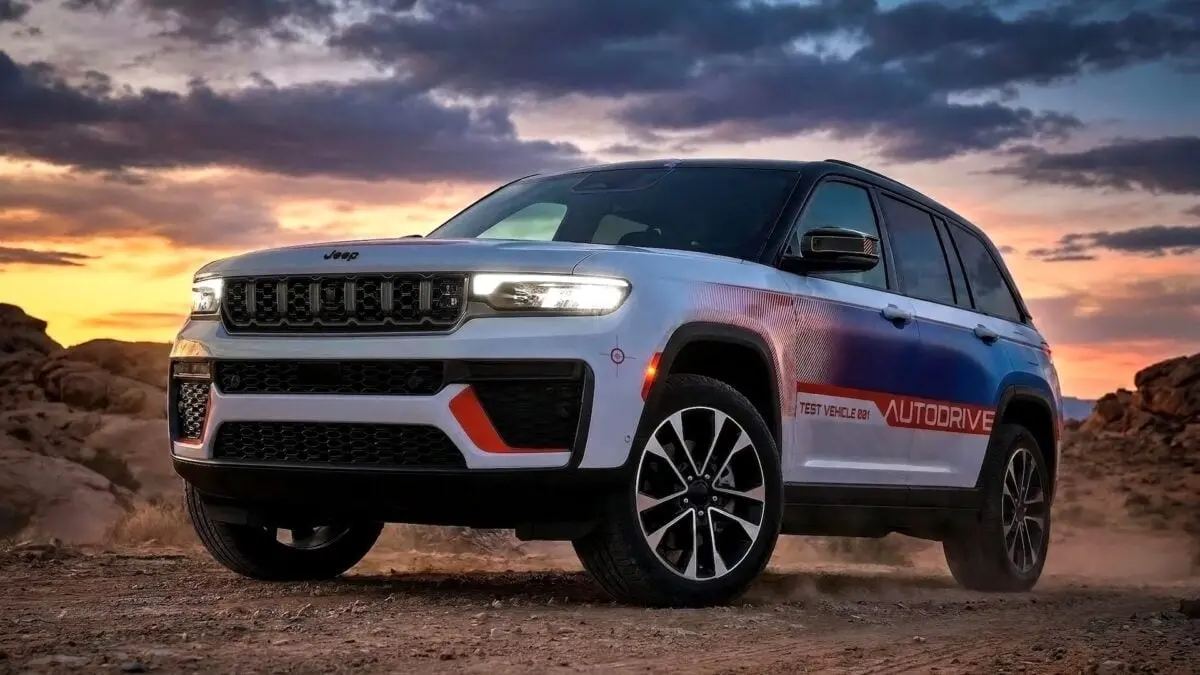
As robotaxi services steadily pop up in cities around the world, self-driving technology in commercial passenger cars has been slow to catch up. Stellantis, the parent company of Jeep, Ram, Dodge, Fiat, and several other car brands, is the latest automaker to announce plans to bring more advanced automated driving tech to its vehicles.
The company announced a new strategic technology partnership with U.K.-based startup Wayve. The partnership aims to integrate Wayve's AI Driver system into Stellantis' STLA AutoDrive platform. This could eventually equip some Stellantis vehicles with hands-free, supervised driving tech that works on both city streets and highways, similar to systems already available on Tesla and Rivian vehicles. Stellantis and Wayve are describing this first iteration as a Level 2++ system, meaning drivers would still need to pay attention to the road and supervise the vehicle as it drives.
The first vehicle integration is planned for North America in 2028. Stellantis says the platform can support more advanced automated driving features down the road as regulations and customer expectations evolve. "This agreement marks an important next step for Wayve and Stellantis in scaling our technology together," said Alex Kendall, co-founder and CEO of Wayve, in a press release. "Our teams have already demonstrated how quickly the Wayve AI Driver can be integrated across Stellantis' vehicle platforms, bringing up a prototype in less than 2 months."
While there is no word yet on which specific brands or models would get the tech first, Wayve developed a prototype with Stellantis in just a few weeks on the company's Jeep Cherokee platform. Founded in 2017, the London startup makes autonomous-driving software that learns from real-world traffic using cameras and machine learning. This theoretically eliminates the need for detailed maps that its competitors rely on. Instead of building its own driverless cars, Wayve is focused on the software, which it says is vehicle-agnostic, meaning it can be adapted to work on everything from passenger cars to delivery vans.
The buzzy startup announced earlier this year that it had closed a $1.2 billion Series D investment round with a range of investors, including SoftBank, Microsoft, Nvidia, and Uber. Just last month, Advanced Micro Devices, Arm, and Qualcomm Ventures announced a separate $60 million investment in the company. Uber's investment will specifically support Wayve-powered robotaxis on the Uber platform. The companies intend to launch their first service in London in 2026, with plans to expand across multiple markets. Nissan has also signed on to use Wayve's technology. In December, the automaker announced that it would integrate Wayve's tech into a broad range of its cars starting in 2027.
Background on Stellantis and the Automated Driving Landscape
Stellantis, formed in 2021 from the merger of Fiat Chrysler Automobiles and Groupe PSA, is one of the world's largest automakers. Its portfolio includes iconic American brands like Jeep, Ram, and Dodge, as well as European marques such as Peugeot, Citroën, Opel, and Fiat. The company has been gradually investing in electrification and advanced driver-assistance systems. Its STLA AutoDrive platform is designed to be scalable, supporting levels of autonomy from basic assisted driving to full self-driving. The partnership with Wayve represents a significant step toward catching up with leaders like Tesla and General Motors' Super Cruise.
The self-driving industry has seen a shift in recent years. While robotaxi pioneers like Waymo and Cruise have focused on fully autonomous fleets, many automakers are prioritizing supervised systems that allow drivers to disengage from steering and pedals under certain conditions. Level 2++ systems, such as Tesla's Full Self-Driving (Supervised) and Ford's BlueCruise, are currently the most advanced commercially available. These systems use a combination of cameras, radar, and sometimes lidar to manage acceleration, braking, and steering on highways and some city roads, but they require constant driver supervision.
Wayve's approach is distinct: it relies on end-to-end machine learning from camera inputs, without high-definition maps or complex rule-based programming. The company trains its neural networks on vast amounts of real-world driving data. This allows the system to handle unfamiliar roads and changing conditions more flexibly. The AI Driver system can be integrated into different vehicle platforms with relatively little customization, which is attractive to automakers like Stellantis that produce a wide variety of models.
Technological Details and Potential Impact
The Wayve AI Driver uses a set of cameras mounted on the vehicle to perceive the environment. The system processes visual data through deep neural networks that have been trained to recognize objects, predict their movements, and plan safe trajectories. Because it avoids reliance on pre-mapped data, it can operate in areas where high-definition maps are not available. This could give Stellantis an advantage in rural or dynamically changing urban environments.
However, there are challenges. End-to-end learning systems are often criticized for being "black boxes" — it can be difficult to understand why a model made a particular decision. Regulators may require more interpretability before approving higher levels of autonomy. Additionally, the system must undergo rigorous validation to ensure safety across diverse driving conditions, from heavy rain to snow to complex intersections with unpredictable pedestrians.
Stellantis plans to start with Level 2++ features, meaning the driver remains legally responsible and must monitor the system at all times. Over time, as Wayve's technology matures and regulations permit, the partnership could evolve to offer Level 3 (conditional automation) or even Level 4 (full self-driving under specific conditions). The STLA AutoDrive platform is designed with redundant hardware to support future upgrades.
The first vehicles equipped with the Wayve system are expected in North America by 2028. Given that the prototype was built on the Jeep Cherokee, it is likely that Jeep — a brand known for off-road capability — will be among the first to feature the technology. Ram trucks and Dodge muscle cars could also benefit, potentially offering hands-free driving on highways and city streets. This would align with Stellantis' goal to make its vehicles more competitive in the fast-evolving automotive tech space.
Wayve's partnerships extend beyond Stellantis. The company has also collaborated with Uber to launch robotaxi services, with Nissan for integration into its global lineup, and has received investments from major chipmakers like Nvidia, AMD, Arm, and Qualcomm. This broad backing indicates confidence in Wayve's technology and its potential to become a leading supplier of autonomous driving software.
The self-driving market is highly competitive, with companies like Mobileye, Waymo, Cruise, Baidu, and numerous startups vying for deals with automakers. Wayve's unique camera-only approach and focus on vehicle-agnostic software could allow it to carve out a significant niche. For Stellantis, adopting Wayve's AI Driver could accelerate its timeline for advanced driver assistance without the heavy research and development costs of building its own system from scratch.
As the industry moves toward greater automation, partnerships like this one will become more common. Automakers need to offer compelling automated driving features to remain relevant, while tech companies need automotive partners to deploy their software at scale. The Stellantis-Wayve collaboration could serve as a model for future alliances, blending automotive manufacturing expertise with cutting-edge AI.
In the coming years, consumers can expect to see more hands-free driving features in mainstream vehicles. The first Stellantis models with Wayve tech are still a few years away, but the groundwork is being laid now. With a strong investment track record and multiple automaker partnerships, Wayve is positioning itself as a key player in the next generation of automotive technology. Stellantis, meanwhile, is betting that integrating Wayve's AI Driver will help its iconic brands stay competitive in an increasingly automated world.
Source: Gizmodo News