

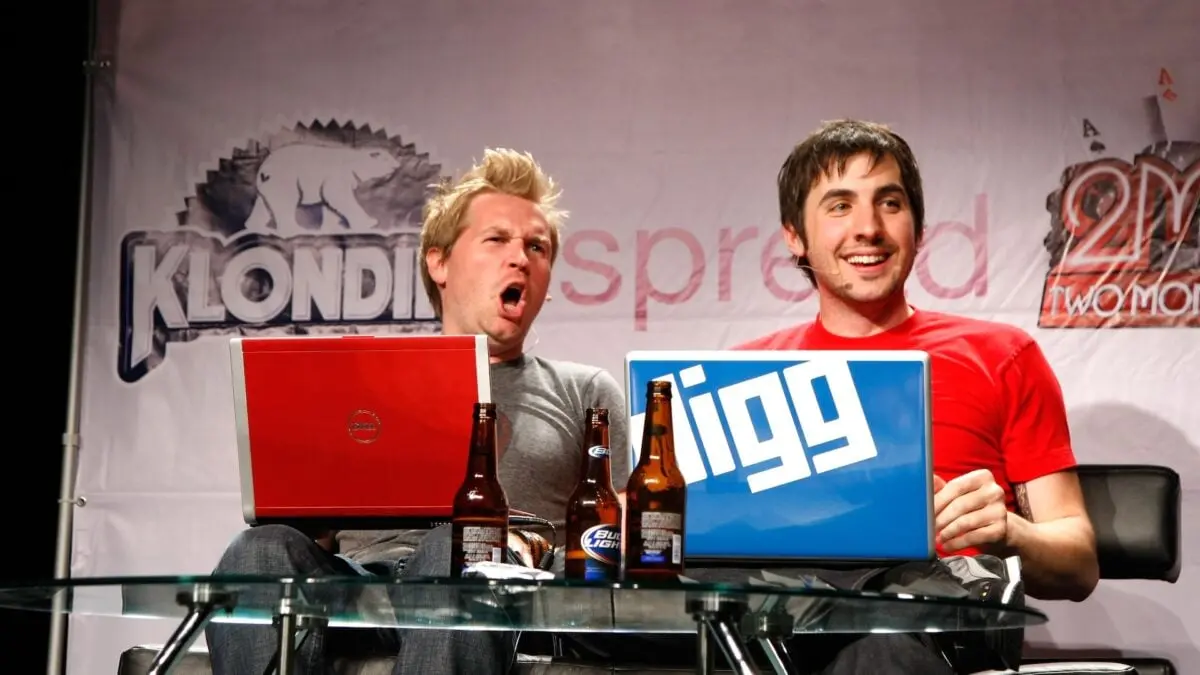
The internet of the mid-2000s was a wilder, more experimental place. Before algorithms ruled feeds and before social media became a battleground for attention, there was Digg. Launched in 2004 by Kevin Rose, Digg was a social news aggregator where users could submit links and vote them up or down. The most popular stories rose to the front page, and in doing so, they could cause a phenomenon known as the “Digg Effect” — a flood of traffic so massive it crashed small servers. It was, in many ways, the original viral internet sensation.
Now, more than two decades later, Digg is back again. This time, it's not trying to compete with Reddit or Twitter. Instead, it has carved out a narrow but timely niche: an AI news aggregator. The new destination, accessible at di.gg/ai, is a spartan, beige feed that collects links to AI-related content — papers, product launches, discussion threads, and hot takes. According to a message on the homepage signed by CEO Kevin Rose, this is only the beginning. “AI is the first vertical. More are coming,” he writes.
The return of Digg has been a convoluted journey. After being acquired by Betaworks in 2012 and then sold multiple times, the platform was eventually reacquired by Rose himself, along with Reddit co-founder Alexis Ohanian, in 2025. The duo announced grand plans to revive the site as a “human-centered” alternative to the algorithm-driven platforms that dominate today. A press release in January 2026 promised innovations that would “prioritize transparency, reward human effort, and foster enriching discussions.” But that iteration barely lasted two months before it was shut down, and most of the staff was laid off.
Now, the phoenix has risen again, albeit in a much simpler form. The current Digg doesn't rely on user submissions or voting in the traditional sense. Instead, it scans X (formerly Twitter) for popular discussions about AI topics, analyzes sentiment and engagement, and then displays the most relevant stories. Each item on the feed is accompanied by clusters of circular avatars — these are the X users who are actively talking about the link. It’s a clever way to leverage existing social signals without building a new community from scratch.
To understand why this matters, it helps to revisit Digg's role in internet history. The popular narrative is that Digg was a primitive version of Reddit that was eventually outshone and forgotten. But that oversimplification misses its true impact. Digg was the site that democratized content curation. It gave ordinary users the power to decide what was important, bypassing traditional gatekeepers like editors and critics. The “Digg This” button became a standard feature on news sites, from the New York Times to personal blogs. It was the precursor to the “Like” button that now dominates social media.
The “Digg Effect” was a term coined to describe the massive traffic spike that followed a front-page appearance. It was a badge of honor and a source of dread for small site owners. If your server couldn't handle the load, you'd go down in flames — but that was a risk many were willing to take for the exposure. That concept has since evolved into “breaking the internet,” but Digg was there first.
Digg's downfall is a well-told story. A controversial redesign in 2010 (often called “Digg v4”) angered the user base, who flocked to Reddit. Reddit's more flexible structure and dedicated communities offered a superior experience. Digg sold for a fraction of its peak value, and for years it languished as a shell of its former self. Yet its DNA is everywhere. The upvote/downvote system, the emphasis on user-driven content, and the idea that the crowd can curate better than editors — all of that can be traced back to Digg.
Now, in 2026, the digital landscape is dominated by AI-generated content and algorithmic feeds that often prioritize engagement over relevance. Rose and Ohanian are betting that a human-curated (or at least human-signaled) approach can cut through the noise. The decision to focus first on AI is strategic. The field is exploding with new papers, products, and controversies. Researchers, developers, and enthusiasts are hungry for a reliable way to filter the signal from the noise. Digg's new feed promises to do exactly that.
But is this enough to revive a once-great brand? The current site is barebones: a simple list of headlines, each with a few lines of text and those X avatars. It lacks the community features that made the original Digg special — no comments, no voting, no badges. Instead, it acts as a bridge to discussions happening elsewhere. Users click through to the source or to the X thread to join the conversation. It’s an aggregator of aggregators, a meta-curator that points to where the action is.
This minimalist approach has a certain elegance. It’s lightweight, fast, and focused. But it also feels tentative. The previous attempt at a full relaunch failed, and this feels like a safer bet — a proof of concept rather than a full-fledged platform. Rose has hinted that more verticals are coming, but for now, the entire site is essentially a single page dedicated to AI news.
The timing is interesting. AI has entered a phase of rapid maturation, with large language models, image generators, and autonomous agents becoming part of everyday life. The news cycle around AI is relentless, with major announcements from companies like OpenAI, Google, and Anthropic happening weekly. There is a real need for a trusted aggregator that can separate breakthrough papers from hype, and genuine advances from marketing fluff. Digg's new model, which relies on the collective wisdom of X users, may be well-suited to that task — provided the signal-to-noise ratio on X remains favorable.
Critics might argue that Digg is simply repackaging Twitter's own trending topics, adding little value. But there is a difference. Twitter's algorithm surfaces content based on a mix of popularity and personalization, often amplifying outrage or trivia. Digg's approach appears to focus on substantive discussions, weighing factors like sentiment and the authority of participants. The result is a feed that feels more curated and less chaotic.
Of course, the proof will be in the adoption. The original Digg had millions of active users. The new version is likely targeting a smaller, more engaged audience — AI enthusiasts, researchers, investors, and journalists. If it can become the go-to destination for this niche, it may have a sustainable future. But the bar is high. There are already dozens of AI newsletters, podcasts, and aggregators. Standing out will require more than a beige background and some X avatars.
The story of Digg is one of reinvention. From social news to a failed redesign to a series of acquisitions to a short-lived relaunch and now to an AI-focused aggregator, the brand has proven remarkably resilient. It never really died; it just kept morphing. Each iteration reflects the zeitgeist of its moment. In 2005, Digg was about user empowerment. In 2026, it’s about taming the flood of information in a specific field.
Kevin Rose, now in his late 40s, has had a varied career since leaving Digg. He founded the social network Google Ventures funded, then moved on to invest in startups and produce podcasts. His return to Digg suggests a nostalgia for the early internet, but also a clear-eyed understanding of what the current market needs. By partnering with Ohanian, who helped build Reddit into a powerhouse, Rose brings both experience and credibility to the venture.
What does the future hold? If the AI vertical succeeds, Digg could expand into other fast-moving fields like biotechnology, space exploration, or renewable energy. The model is scalable: just point the algorithm at a new set of X conversations and apply the same curation logic. But scaling also brings challenges. The more verticals Digg adds, the harder it becomes to maintain quality. And as AI-generated content proliferates, distinguishing between genuine human discourse and bot-driven campaigns will become increasingly difficult.
For now, Digg is a placeholder, a work in progress. It’s a reminder that even the most iconic internet brands can adapt, though not always gracefully. The original Digg changed the internet by giving power to the people. This new version is more modest — it helps you keep up with the news. That may not be revolutionary, but in a world drowning in information, it’s a useful service. Whether it’s enough to make Digg matter again remains to be seen.
As the homepage says, “Hello Again.” It’s a quiet greeting, not a grand proclamation. After all the comebacks, false starts, and pivots, maybe that’s the right tone. Digg is back, not as a revolution, but as a tool. And sometimes, that’s all you need.
Source: Gizmodo News