

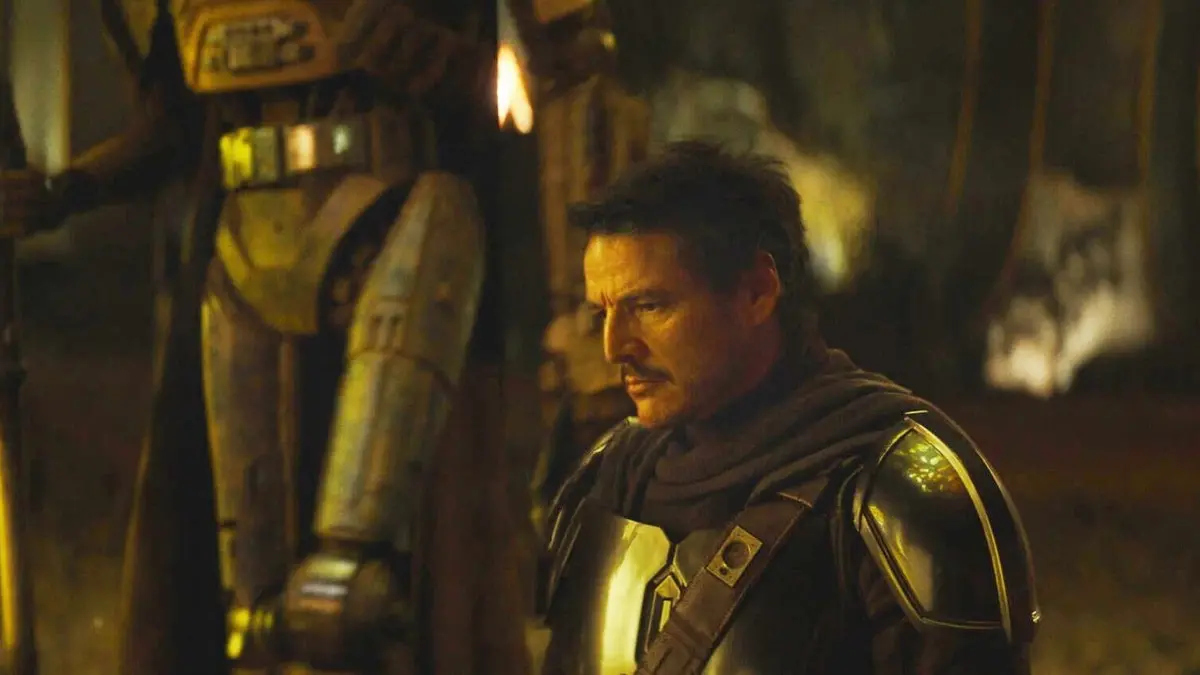
With the release of "The Mandalorian and Grogu," the first new "Star Wars" film in seven years, fans expected to see Pedro Pascal reprise his iconic role as Din Djarin, the bounty hunter known as the Mandalorian. However, instead of a triumphant return with substantial screen time, Pascal has inadvertently set a rather unexpected record: he has the least amount of face time of any lead actor in a "Star Wars" movie to date.
The film, which continues the story from the Disney+ series "The Mandalorian," sees Din Djarin and his foundling Grogu (affectionately known as "Baby Yoda") embarking on a new adventure across the galaxy. While the character is integral to the plot, Pascal appears unmasked for only a few minutes. According to reports, his total unmasked screen time amounts to roughly four and a half minutes, spread across a single sequence later in the film. In contrast, the movie itself runs nearly two and a half hours, meaning Pascal's visible presence accounts for less than 4% of the total runtime.
This minimal exposure is not entirely new for Pascal, who has portrayed the helmeted Mandalorian since the series' debut in 2019. The character's strict adherence to the Creed—a religious code that forbids removing one's helmet in the presence of others—has always limited opportunities for displaying Pascal's face. In the three seasons of "The Mandalorian," spanning 24 episodes and over 16 hours of content, Pascal's face appears for a cumulative total of just under four minutes. The first major unmasking occurred in Season 1, Episode 8, lasting a mere 19 seconds. Subsequent glimpses in later seasons added only a few more seconds each time.
The Helmet Rule and Its Impact on Storytelling
This unique narrative constraint has become a defining characteristic of the Mandalorian's journey. In the lore of "Star Wars," Mandalorians are a warrior culture with a strict code that includes not removing one's helmet in front of others. For Din Djarin, this rule stems from his upbringing by the conservative "Children of the Watch" sect. The decision to maintain this rule throughout both the series and the film has allowed the filmmakers to emphasize the character's stoic persona while also making those rare moments of vulnerability—when the helmet comes off—all the more impactful. Each unmasking serves as a significant emotional beat, whether it be to reveal his face to Grogu, to share a rare moment of intimacy with a quest-giver, or, in the film, to struggle against enemies who forcibly remove his helmet during a fight with water creatures on the planet of the Hutt twins.
However, the helmet rule also presented practical challenges, especially given Pascal's busy schedule. The actor was simultaneously filming Marvel's "Fantastic Four: First Steps," which required his full presence on set for extended periods. As a result, the production of "The Mandalorian and Grogu" relied heavily on Pascal's stunt doubles, Brendan Wayne and Lateef Crowder, who performed the majority of the armored scenes. Wayne, the grandson of John Wayne, has served as Pascal's primary physical double for the series, handling most of the action sequences and walking shots. Crowder, a renowned Capoeira expert, executed the more complex fight choreography. Pascal only needed to appear for scenes requiring his face or voice, which considerably reduced his on-set time.
Director Jon Favreau and the creative team have long acknowledged that the Mandalorian's helmet is not just a character trait but a storytelling device. It shifts the focus from facial expressions to body language, voice modulation, and the dynamic between the armored figure and the puppet animatronic of Grogu. This approach has been praised for adding depth to a character who speaks little but conveys much through gestures and posture. Yet, the extreme brevity of Pascal's unmasked moments in the film—almost entirely confined to a single sequence—has surprised even dedicated fans.
A Record in the Star Wars Universe
Comparing Pascal's screen time to other lead performances in "Star Wars" films highlights how unprecedented this is. Mark Hamill's Luke Skywalker appeared in almost every scene of the original trilogy, as did Harrison Ford's Han Solo. Even in the prequels, Ewan McGregor's Obi-Wan Kenobi and Hayden Christensen's Anakin Skywalker were visible for the vast majority of their films. In the sequel trilogy, Daisy Ridley's Rey was the centerpiece, seldom off-screen. To find a lead actor with such limited visible presence, one would have to look at voice-only characters like James Earl Jones as Darth Vader (though Vader's physical presence was often played by David Prowse), but that is a different category. Pascal's situation is unique: he is the lead actor credited for a character who appears throughout the film but whose face is hidden for all but a few minutes.
The record also extends to the series itself. Across 24 episodes, Pascal's face was shown for a total of approximately 3.5 minutes, as calculated by fan sites like ScreenRant. This means the film's 4.5 minutes of unmasked footage actually represents a significant increase relative to the series per minute of runtime. Yet, given the film's length, the overall proportion remains remarkably low. The achievement has sparked discussions among fans and critics about the nature of lead performances in modern franchise filmmaking, where actors often share the screen with digital doubles, stunt performers, and extensive VFX work.
Pedro Pascal's career has been defined by versatility, from his breakout role as Oberyn Martell in "Game of Thrones" (where he appeared in only seven episodes but made a lasting impression) to his acclaimed performances in "Narcos," "The Last of Us," and the "Star Wars" universe. His ability to convey emotion and character through voice alone—even when hidden behind a helmet—has made him a fan favorite. In "The Mandalorian and Grogu," his vocal performance is crucial, as Din Djarin speaks in a measured, gravelly tone that can shift from stern protection to tender care for Grogu. The few moments when his face appears carry extra weight, as they break the long-awaited barrier of anonymity.
Behind the Scenes: Scheduling and Production
The production of "The Mandalorian and Grogu" took place over several months in 2024, overlapping with the filming of "Fantastic Four: First Steps," which shot in multiple locations including London and New Mexico. Pascal had to divide his time between these two major projects, plus promotional obligations for "The Last of Us" Season 2 and other commitments. Industry insiders revealed that the "Star Wars" film was structured to accommodate Pascal's availability, with most of Din Djarin's scenes filmed in batches where Pascal could be present. However, the bulk of action sequences—especially those requiring the full armored suit—were handled by Wayne and Crowder, who have been with the series since its inception.
Favreau and the production team have emphasized that this arrangement did not compromise the film's quality. Advances in motion-capture and audio editing allowed Pascal to dub over many of his double's performances, ensuring consistent voice delivery. The filmmakers also used creative camera angles and lighting to maintain the illusion of a single performance. In interviews, Pascal praised his doubles, noting that their physicality and understanding of the character were essential. "Brendan and Lateef are the ones who truly make the Mandalorian move and fight," he said in a press conference. "I just have to show up for the emotional moments."
The film's cinematography also reflects this approach. Long shots of the Mandalorian walking through alien landscapes or engaging in combat are carefully choreographed to emphasize the armor's weight and the character's presence, rather than the actor's face. Close-ups are reserved for the occasional moments where the helmet is removed, or when the camera lingers on Grogu's expressive face. This technique has drawn comparisons to classic Westerns, where rugged heroes often hide their emotions behind hats and shadows.
Fan Reactions and Legacy
Upon the film's opening weekend, fan reactions were mixed but largely positive regarding Pascal's limited screen time. Many appreciated the narrative consistency with the series, where the helmet rule was always upheld. Others expressed mild disappointment, having hoped for more extended scenes of Pascal's portrayal without the mask. However, most agreed that the emotional payoff of the unmasking sequence—where Din Djarin's face is finally shown after a tense underwater battle—was worth the wait. The scene reportedly drew applause in some theaters.
Social media discussions quickly turned to the record itself. Fan accounts crunched the numbers, comparing Pascal's screen time to other franchises. The consensus is that no other leading actor in a blockbuster franchise has had such a small percentage of face time while still being the central protagonist. This sets a new benchmark for the "Star Wars" saga and raises questions about how future productions might handle similar constraints. Could other characters, such as Boba Fett (who also wears a helmet), follow this model? Or will audiences eventually tire of such anonymity?
For Pedro Pascal, the record adds another chapter to his already fascinating career. He has become known for taking on roles that allow him to hide behind masks, prosthetics, or heavy makeup—as seen in "Wonder Woman 1984" (as Maxwell Lord) and "The Unbearable Weight of Massive Talent" (as himself). His ability to command a screen even when obscured is a testament to his vocal range and physicality. As "The Mandalorian and Grogu" continues its box office run, discussions about the nature of lead performances in the age of streaming and massive franchise will undoubtedly persist.
In the meantime, Din Djarin's journey is far from over. With the film ending on a cliffhanger that teases further adventures, fans eagerly await news of future projects. Whether Pascal's screen time will increase remains to be seen, but the precedent has been set: less can indeed be more, especially when that less carries the weight of an entire galaxy far, far away.
Source: watson.de News