

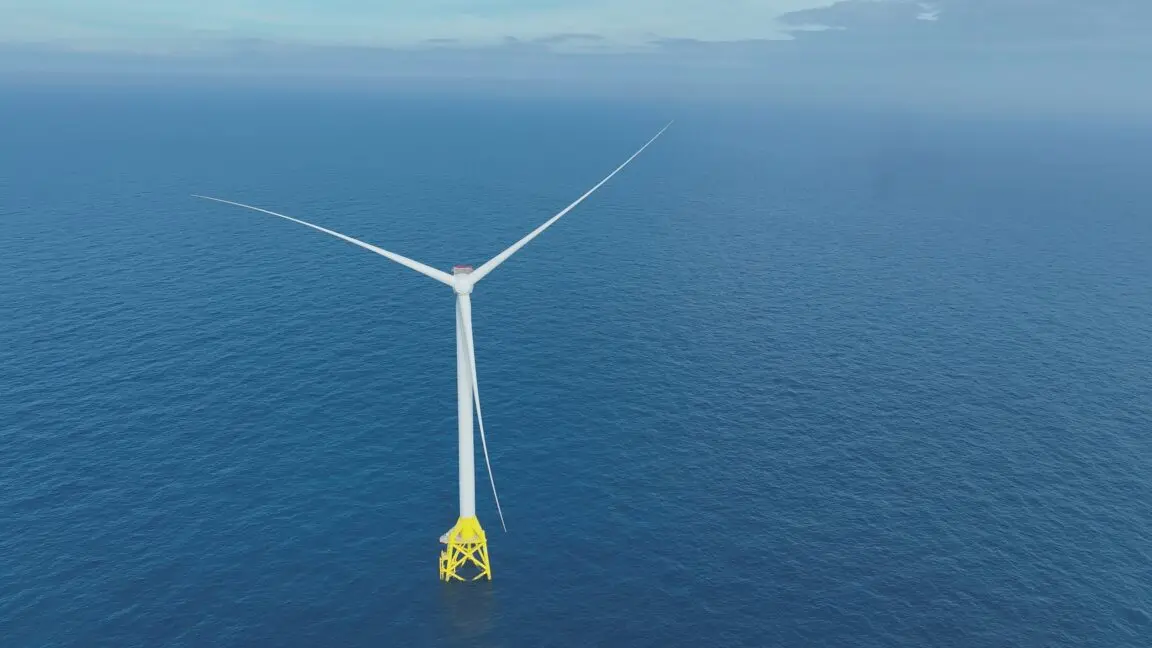
Taiwan Semiconductor Manufacturing Company (TSMC), the world's leading advanced chipmaker, is riding a wave of record profits fueled by insatiable demand for artificial intelligence processors. Yet behind the financial success lies a mounting challenge: securing enough clean energy to power its sprawling fabrication plants. In a decisive move that underscores the intersection of technology and geopolitics, TSMC has signed a landmark 30-year corporate power purchase agreement (PPA) to buy the entire output of the Hai Long offshore wind project off the coast of central Taiwan.
The deal, announced on April 30, involves more than 1 gigawatt (GW) of capacity across three wind farm sites in the Taiwan Strait. Once fully operational by 2027, the project is expected to generate enough electricity to power the equivalent of over one million Taiwanese households. The wind farms began feeding power into Taiwan's grid in early 2025, with phased commissioning extending through the next two years. TSMC's partner in the venture is Northland Power, a Canadian-based global power producer with extensive experience in offshore wind development.
Taiwan's Energy Dependency and the Global Crisis
Taiwan relies on imported fossil fuels to meet nearly 97% of its overall energy needs, including electricity, transportation, and heating. Natural gas alone accounts for about half of the island's electricity generation. This heavy dependence has left Taiwan extremely vulnerable to supply shocks. In March 2026, an escalation of conflict in the Middle East resulted in Iranian drone strikes damaging key natural gas facilities in Qatar, one of Taiwan's primary liquefied natural gas (LNG) suppliers. According to Bloomberg, the incident instantly deprived Taiwan's power grid of roughly one-third of its usual LNG supply.
With only two weeks of fuel reserves typically on hand, the government scrambled to avert blackouts. Emergency measures included tapping alternative suppliers such as Australia and the United States, as reported by Reuters. During an energy forum on May 6, Taiwan's vice minister of economic affairs stated that the government had secured enough oil and gas supplies to maintain normal operations through August and possibly into September, according to Taiwan News. However, the episode served as a stark reminder of the fragility of Taiwan's energy security, especially as the global energy crisis intensifies due to geopolitical instability.
President Lai Ching-te's administration has responded by accelerating efforts to diversify energy sources. Plans include restarting some shuttered nuclear power plants and massively expanding renewable energy projects. A government target calls for 15 GW of offshore wind capacity to be available to developers by 2035. The push for renewables is not merely an environmental goal but a strategic imperative for a nation that must secure its energy future while hosting the world's most critical chip supply chain.
TSMC's Growing Energy Appetite
TSMC's role in shaping Taiwan's energy landscape cannot be overstated. According to a 2023 report from the International Energy Agency (IEA), the chipmaker consumed nearly 10% of Taiwan's total electricity that year. That share is projected to rise dramatically. S&P Global estimates, cited by Data Center Dynamics, suggest TSMC could account for nearly one-quarter of Taiwan's overall electricity usage by 2030. This surge is driven by the company's heavy investments in advanced manufacturing processes—specifically the extreme ultraviolet (EUV) lithography technology required to produce the most powerful AI chips. Each EUV tool can consume as much electricity as a small town, and TSMC operates dozens of them across its fabs.
The company has publicly committed to sourcing 60% of its global operations' energy from renewable sources by 2030 and 100% by 2040. The Hai Long PPA is a cornerstone of that strategy, but it is not TSMC's first major renewable energy deal. In 2020, the chipmaker signed a similar agreement with Danish renewable energy leader Ørsted for 920 megawatts (MW) from the Greater Changhua offshore wind farm project, which is expected to become fully operational later in 2026. A year later, TSMC also struck a deal with German developer WPD to jointly develop more than 1 GW of onshore and offshore wind power capacity. These agreements, combined, represent a significant shift in how one of the world's most strategic companies manages its energy procurement.
Technical and Economic Implications
The expansion of offshore wind in Taiwan is not without technical and economic challenges. The Taiwan Strait experiences strong, consistent winds that make it one of the best offshore wind resource areas in the world, but it also faces typhoons and seismic activity. Developers have had to innovate with foundation designs and turbine technology to ensure resilience. The cost of offshore wind has declined significantly over the past decade, but projects still require substantial upfront investment. Long-term PPAs like TSMC's provide the revenue certainty developers need to secure financing, while giving the chipmaker a predictable price for clean power.
From an economic perspective, TSMC's energy investments also have geopolitical implications. The company's fabs are concentrated in Taiwan, and any disruption to power supply could ripple through global tech supply chains. Tech giants like Apple, Nvidia, and AMD depend on TSMC for their most advanced chips. The energy crunch therefore poses a risk not only to Taiwan but to the entire global AI ecosystem. By securing its own renewable energy, TSMC mitigates some of that risk and demonstrates a model for other energy-intensive industries.
The AI boom shows no signs of slowing. Data centers, which are the backbone of AI training and inference, consume enormous amounts of electricity, and the chips inside them are predominantly manufactured by TSMC. As more companies deploy large language models and other AI applications, the demand for advanced chips will continue to soar. That demand, in turn, drives the need for even more chip fabrication capacity, which requires more energy. TSMC's wind power deals are therefore part of a virtuous cycle: scaling up renewable energy to power the very technology that may help optimize energy systems elsewhere.
Taiwan's government has also been proactive in streamlining permitting processes for offshore wind projects. The Hai Long project alone required coordination among multiple ministries—economic affairs, environment, and transportation—as well as local community engagement. The success of this project could serve as a template for future developments. If Taiwan can meet its 15 GW target, it would become a major hub for offshore wind, reducing both its carbon footprint and its reliance on volatile fossil fuel imports.
Meanwhile, TSMC continues to expand its manufacturing footprint. The company is building new fabs in Japan, Germany, and the United States, partly in response to geopolitical pressures to diversify chip production. However, the vast majority of its advanced capacity remains in Taiwan, meaning the energy challenge will persist. The company has also invested in energy efficiency measures at its fabs, including heat recovery systems and more efficient cleanroom designs, but the relentless demand for computing power means overall consumption will keep rising.
In the broader context, the TSMC-Hai Long deal exemplifies how corporate demand can drive infrastructure development. Without a large buyer like TSMC committing to a 30-year PPA, the Hai Long project might have faced more financial hurdles. This model is being replicated in other sectors, with tech companies signing similar agreements with solar and wind farms across Europe and the United States. For Taiwan, securing such agreements is vital not only for its energy transition but also for maintaining its status as the indispensable supplier of advanced semiconductors.
The timeline for the Hai Long project is ambitious. The first turbines began feeding power in 2025, and full commercial operation is scheduled by 2027. If successful, it will be one of the largest offshore wind projects in the Asia-Pacific region. Combined with TSMC's other renewable energy efforts, it represents a significant step toward the company's 2040 net-zero goal. For Taiwan, it is a critical piece of a larger puzzle: how to keep the lights on while powering the AI revolution.
Source: Ars Technica News