

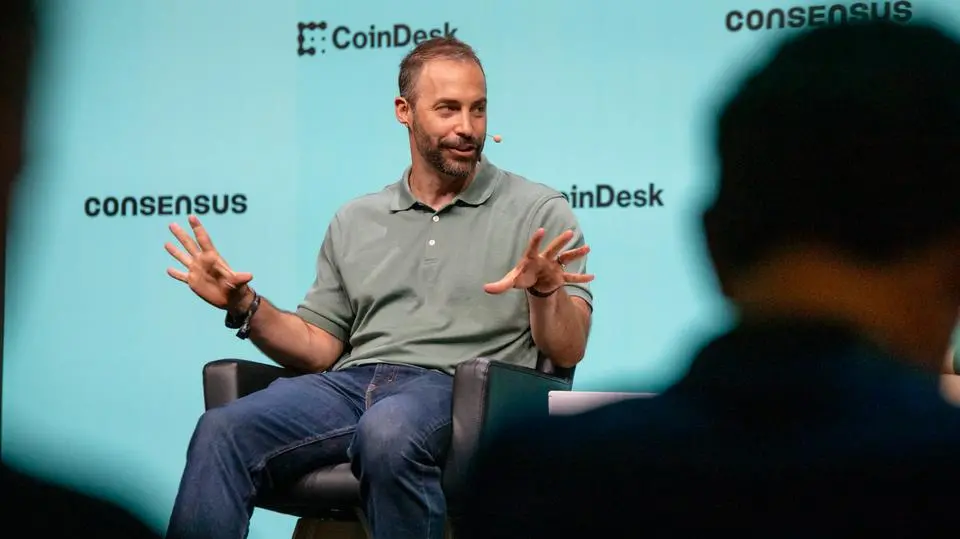
At CoinDesk's Consensus Miami conference on Wednesday, Alex Pruden, CEO of Bitcoin infrastructure firm Project Eleven, delivered a stark warning: Bitcoin's migration to post-quantum signatures will be far more challenging than the Taproot upgrade and must begin without delay. Pruden, a former executive at the Bitcoin-focused venture firm Stillmark, emphasized that the asymmetry between acting now—based on the known vulnerability of Bitcoin's current Elliptic Curve Digital Signature Algorithm (ECDSA)—and waiting for certainty about quantum-computing hardware timelines means developers should shift from research into production.
Pruden's remarks come amid growing concerns that sufficiently powerful quantum computers could break the cryptographic underpinnings of Bitcoin, potentially allowing an attacker to forge signatures and steal coins. While large-scale quantum computers remain theoretical, researchers have made steady progress; a 2019 Google Sycamore processor achieved quantum supremacy on a specific task, and newer systems with over 1,000 qubits have been announced by IBM and others. The U.S. National Institute of Standards and Technology (NIST) has already selected several post-quantum cryptographic algorithms for standardization, including CRYSTALS-Kyber for key encapsulation and CRYSTALS-Dilithium for digital signatures.
The Taproot analogy
Pruden drew a direct comparison to Taproot, Bitcoin's most significant upgrade since SegWit. Taproot, activated in November 2021 after roughly five years of development, introduced Schnorr signatures and Merkelized Abstract Syntax Trees (MAST), improving privacy and efficiency. However, Taproot was optional: users and services could choose to ignore it and continue using legacy addresses without immediate harm. "It was a big effort, but it was opt-in, and the world did not end for those who didn't upgrade," Pruden noted.
The post-quantum migration, by contrast, cannot be opt-in. Bitcoin's current ECDSA signatures will become forgeable once a sufficiently powerful quantum computer exists. Every Bitcoin user, wallet provider, exchange, and node operator will need to upgrade to a new signature scheme—likely based on lattice cryptography or hash-based signatures—to ensure their funds remain secure. Anyone who refuses or delays will risk losing access to their coins. Pruden called this "a coordination challenge of unprecedented scale."
Technical hurdles
Replacing the signature scheme in a decentralized, permissionless network like Bitcoin is not straightforward. The Bitcoin Improvement Process (BIP) and community consensus are required to activate a soft fork or hard fork that introduces a new script opcode for post-quantum signatures. While Bitcoin's community has a strong track record of careful upgrades—SegWit and Taproot both took years—the post-quantum change affects the core security model. Key considerations include signature size (post-quantum signatures are often kilobytes compared to 64–72 bytes for ECDSA), verification speed, and backward compatibility.
Pruden pointed out that some post-quantum schemes, like SPHINCS+, have relatively large signatures that could bloat the blockchain and increase fees. Others, like Falcon, offer smaller sizes but have complex implementations. The Bitcoin Core development team would need to evaluate trade-offs thoroughly. Additionally, existing hardware wallets and mining equipment might require firmware upgrades or even replacement to support new algorithms, a logistical nightmare given the hundreds of millions of dollars in dedicated hardware.
The timeline debate
When should the migration begin? Pruden argued that waiting for proof of a quantum computer capable of breaking Bitcoin would be catastrophic. "If we wait until the threat is undeniable, it will be too late. The migration itself will take years, and during that transition period, the network is vulnerable." He cited estimates from cryptographers that a quantum computer with roughly 1,500 logical qubits could break ECDSA-256, the curve used by Bitcoin. Current systems have far more physical qubits but low error rates; projections suggest a meaningful quantum computer could exist within 10 to 20 years, though some experts say sooner.
Pruden's call for immediate action mirrors warnings from other industry figures. Adam Back, CEO of Blockstream and co-inventor of Hashcash, has said that Bitcoin should have a post-quantum plan in place before 2030. The Ethereum ecosystem has already begun experimenting with post-quantum address formats. However, critics argue that rushing could lead to poorly vetted algorithms and unnecessary risk. Pruden acknowledged the tension: "We don't want to break things that aren't broken, but we also don't want to be caught flat-footed."
Implications for dormant coins
During a Q&A session, Pruden was asked about what might happen to Bitcoin held in addresses that have been dormant for years—so-called lost or forgotten coins—if a quantum attack becomes imminent. Recovering those coins would require their owners to upgrade before the attack, but many owners may have died, lost their private keys, or simply not followed the news. Pruden offered a personal view: he would support recycling such coins back into Bitcoin's supply curve rather than allowing them to be stolen. "Overall, I'm on the confiscation side, but I stress that the community and market will ultimately decide through governance."
This controversial topic echoes debates around Bitcoin's 21 million supply cap and the immutability of transactions. Some purists argue that any forced redistribution violates the core property of non-confiscation. Others maintain that if a technical necessity (quantum vulnerability) makes certain coins impossible to secure, it might be better to burn them or redistribute them fairly. Pruden stressed that his opinion was not official Project Eleven policy, but a reflection of the difficult choices ahead.
Historical context
Bitcoin has survived several existential threats: the 2013/2014 Mt. Gox collapse, the 2017 scaling wars, and regulatory crackdowns. The quantum computing threat, however, strikes at the mathematical foundation. Satoshi Nakamoto chose ECDSA for its security and efficiency, but quantum computing was not a widespread concern in 2009. Today, the National Security Agency (NSA) and other organizations have already begun migrating to quantum-resistant algorithms for classified systems.
The financial stakes are enormous. As of May 2026, Bitcoin's market capitalization exceeds $1.6 trillion. If a quantum attacker broke Bitcoin's cryptography, they could drain any unupgraded address, potentially halving the circulating supply. Even the possibility of such an event could trigger a panic, driving down prices and undermining trust. Proactive migration, Pruden argued, is the only way to preserve the network's integrity.
What needs to happen next
Pruden outlined a roadmap: first, the Bitcoin community must select one or more post-quantum signature schemes for testing. Second, developers must propose and implement a BIP that adds a new script version or opcode to support those signatures. Third, wallet providers, exchanges, and mining pools must upgrade their software. Finally, users should move their bitcoins to new, quantum-resistant addresses—a process that could take years.
He drew parallels to the Y2K bug, where massive coordinated effort averted a crisis that might have been minor. "We have the luxury of time, but not infinite luxury. Use it wisely." Project Eleven is developing tools to facilitate the transition, including libraries for post-quantum signing and wallet compatibility modules. The company recently raised a Series B round led by Polychain Capital to accelerate this work.
The broader crypto industry is also waking up: the Ethereum Foundation has a post-quantum research group, and several layer-2 solutions are experimenting with quantum-resistant proofs. Yet Bitcoin's decentralized and conservative nature makes it the hardest to upgrade. Pruden's message at Consensus Miami was clear: the research phase is over; it's time to build. For developers, the challenge is immense; for the community, the decision is urgent. If Bitcoin is to remain the king of cryptocurrencies for another decade, its foundations must be quantum-proof.
Source: Coindesk News