

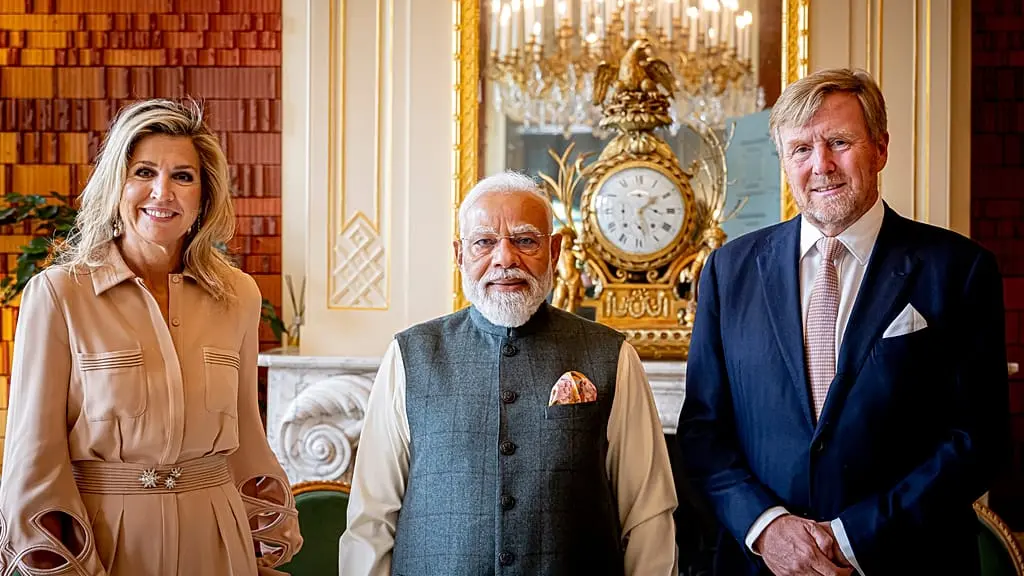
Indian Prime Minister Narendra Modi officially kicked off the European segment of his high-stakes diplomatic tour on Saturday, arriving in The Hague, Netherlands. The visit marks the beginning of a carefully orchestrated journey aimed at deepening India's engagement with key European partners across trade, technology, defense, and energy security. Modi's six-day itinerary, which also includes stops in Sweden, Norway, and Italy, reflects New Delhi's strategy to strengthen ties with both individual nations and the European Union as a bloc.
Modi's Arrival in the Netherlands
Upon landing in Amsterdam, Modi was received with full ceremonial honors before proceeding to the royal palace Huis ten Bosch in The Hague. There, he met with King Willem-Alexander and Queen Máxima of the Netherlands, marking the first bilateral visit by an Indian prime minister to the country in over a decade. The royal meeting underscored the historic and cultural ties between India and the Netherlands, which date back to the Dutch East India Company era. However, the core agenda was firmly anchored in modern geostrategic and economic realities.
Later in the day, Modi held talks with Dutch Prime Minister Rob Jetten. According to official readouts, the leaders discussed a broad spectrum of issues, including defense cooperation, maritime security, innovation, renewable energy, and digital infrastructure. The Netherlands is one of India's largest trading partners within the European Union, with bilateral trade reaching a record $27.8 billion in the 2024-25 fiscal year. Indian exports to the Netherlands include chemicals, textiles, and machinery, while Dutch investments flow heavily into Indian logistics, agri-tech, and water management projects.
Strategic Significance of the Dutch Visit
The choice of the Netherlands as the first stop is strategic. The Netherlands is not only a major gateway for Indian goods entering Europe but also a hub for technology and innovation. Modi highlighted technology and innovation as new pillars of the partnership during a meeting with members of the Indian diaspora in The Hague. He praised the growing community of Indian professionals in the Netherlands, many of whom work in the tech sector, as living bridges between the two economies.
Moreover, the Netherlands shares India's interest in combating climate change. With over a third of its land below sea level, the Dutch have pioneered water management technologies that are highly relevant for India's own flood-prone regions and irrigation challenges. A joint working group on water management has been active since 2017, and both sides are expected to sign new agreements in this field during Modi's stay.
Next Stops: Sweden, Norway, and Italy
After concluding his engagements in the Netherlands, Modi will fly to Sweden, where he is scheduled to meet Prime Minister Ulf Kristersson. The two leaders are expected to "review the entire spectrum of bilateral relations," according to India's Ministry of External Affairs. Key topics include sustainable urbanization, green technology, and defense cooperation—Sweden’s Saab has been a long-standing partner in India's defense modernization, though no specific deals have been confirmed.
In Stockholm, Modi will also participate in the European Round Table for Industry (ERT) alongside EU Commission President Ursula von der Leyen. The ERT gathering brings together CEOs of major European corporations and top policymakers. Modi's presence underscores India's push for increased European investment under its "Make in India" and "Atmanirbhar Bharat" (Self-Reliant India) initiatives. Von der Leyen and Modi last met at the 16th EU-India Summit in January 2025, where negotiations on a long-awaited free trade agreement were successfully concluded. The FTA aims to reduce tariffs and regulatory barriers, potentially boosting bilateral trade by billions of dollars over the next decade.
From Sweden, Modi will travel to Oslo for the third India-Nordic Summit, a forum that brings together heads of state and government from Norway, Sweden, Denmark, Finland, and Iceland. The summit focuses on cooperation in technology, renewable energy, defense, space research, and Arctic affairs. As non-Arctic states, India and the Nordic countries share an interest in sustainable development and scientific exploration of the polar region. India's polar research station in Svalbard, Ny-Ålesund, has been operational for years, and enhanced cooperation with Arctic Council members like Norway and Iceland is a priority.
The final stop of the tour is Rome, Italy, where Modi will meet Prime Minister Giorgia Meloni on May 20. In 2024, the two leaders signed a "Joint Strategic Action Plan" covering security and defense cooperation, cyber security, counter-terrorism, and the promotion of "safe and legal migration pathways." Italy is a key European partner for India, particularly in the Mediterranean and African corridors. The upcoming meeting is expected to build on these agreements, with announcements concerning technology transfers and joint infrastructure projects in third countries.
India-EU Relations: A Broader Canvas
Modi's European tour comes at a crucial juncture in India-EU relations. The conclusion of the FTA negotiations in January 2025 was hailed as a historic breakthrough after years of stalled talks. The deal covers more than just trade; it includes provisions on data protection, digital trade, and intellectual property rights, aligning with the EU's “Digital Decade” goals. For India, the FTA provides preferential access to a market of over 450 million consumers, while the EU gains a foothold in one of the world's fastest-growing major economies.
However, challenges remain. EU concerns about India's carbon border adjustment mechanism and agricultural subsidies could complicate ratification. But both sides appear committed to moving forward, with the European Parliament expected to vote on the agreement later this year. Modi's personal diplomacy in Europe is likely aimed at smoothing over remaining political hurdles and deepening goodwill among EU member states.
Meanwhile, India's relations with each Nordic country have distinct flavors. India and Norway have strengthened ties through the India-Norway Marine Research Initiative, which focuses on sustainable fisheries and marine biodiversity. Denmark and India collaborate on green hydrogen and wind energy, while Finland’s expertise in education technology is being tapped to improve India's school system. Iceland and India have a history of geothermal energy cooperation. The Nordic summit will emphasize a unified approach to renewable energy and innovation.
Trade and Investment Highlights
The trade figures released by India's Ministry of Commerce show that the Netherlands accounted for the largest share of India's exports to the EU in 2024-25, followed by Germany and Belgium. Indian companies like Tata Consultancy Services (TCS), Infosys, and Mahindra have significant operations in the Netherlands. On the investment side, Dutch multinationals such as Philips, Shell, and Unilever have a long-standing presence in India. The Netherlands is also the third-largest foreign investor in India, after Mauritius and Singapore, with a cumulative investment of over $30 billion.
In Sweden, Indian firms like Volvo and Ericsson have major operations, while Swedish companies such as Atlas Copco and Sandvik have manufacturing plants in India. The defense relationship is particularly noteworthy: Sweden is one of the few countries that has not imposed an arms embargo on India, and the two collaborate on naval systems and aircraft components.
Italy is India's 12th-largest trading partner in the EU, with bilateral trade around $7 billion. Italian fashion and luxury brands like Prada and Gucci have a growing middle-class market in India, while Indian IT firms provide services to Italian banks and telecoms. The strategic action plan signed by Modi and Meloni also includes cooperation on artificial intelligence and space technology, areas where both nations have demonstrated capabilities.
Geopolitical Context
Modi's European tour also fits into India's broader foreign policy of multi-alignment. While maintaining close ties with Russia and China, India has been strengthening partnerships with like-minded democracies in the West. Europe offers India not only economic opportunities but also strategic autonomy in the face of rising global uncertainties. The war in Ukraine has made energy security a top priority, and Modi's discussions in Norway—one of Europe's largest oil and gas exporters—are expected to cover energy diversification.
Furthermore, the Indo-Pacific region is a growing area of convergence between India and Europe. The EU's Indo-Pacific Strategy, released in 2021, aligns closely with India's own vision for a free and open Indo-Pacific. Joint naval exercises, maritime domain awareness cooperation, and infrastructure connectivity projects like the India-Europe connectivity partnership are all on the agenda.
Modi's diplomatic marathon demonstrates India's determination to position itself as a global player capable of bridging the North-South divide. By engaging both large EU powers and smaller Nordic states, New Delhi is building a robust network of bilateral relations that complement its engagement at the multilateral level in the G20, BRICS, and the UN.
Source: Yahoo News News