

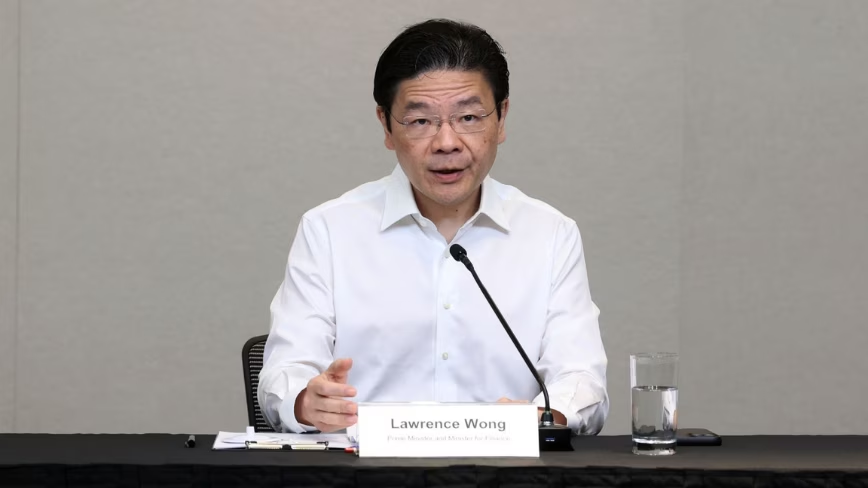
Singapore's parliament has formally reaffirmed Prime Minister Lawrence Wong's pledge that artificial intelligence will not lead to jobless growth in the city-state. The commitment, first made during the February 26 parliamentary debate on the 2026 Budget, represents one of the most explicit positions a major Asian economy has taken on the intersection of AI deployment and employment. Wong told lawmakers that his government would harness AI to expand the economy while ensuring that the resulting growth translates into good jobs and higher wages, directly addressing mounting worker anxieties over automation and digital transformation.
The pledge is rooted in three specific concerns that opposition and backbench MPs raised during the budget debate. First, that greater AI adoption could reduce employer investment in worker training as firms prioritise machine efficiency over human capital development. Second, that older workers re-entering the workforce would face disproportionate barriers, particularly if reskilling programmes are not tailored to their experience and learning pace. Third, that entry-level professional, managerial, executive, and technician (PMET) roles could be hollowed out before structural adjustments have time to take effect. Wong responded by stating that the government would act proactively to prevent each outcome, rather than wait for job displacement to trigger a reactive policy overhaul.
Singapore's current labour market provides a favourable baseline for such a pledge. The proportion of permanent employees has reached a record high of nearly 91 percent, with gains spread across most sectors. Job vacancies continue to outnumber job seekers, and more than 40 percent of openings are entry-level PMET positions. These figures make the no-jobless-growth promise plausible in the near term, but the fundamental challenge lies in whether the pattern will hold as AI deployment accelerates across industries such as advanced manufacturing, logistics, finance, and healthcare.
Government programmes and national AI missions
Wong has paired his rhetorical commitment with concrete spending and institutional frameworks. The Champions of AI programme offers tailored support to firms that aspire to undertake comprehensive AI-driven business transformation. This includes enterprise transformation consulting and workforce training subsidies designed to help companies integrate AI without shedding employees. The government has also identified four national AI missions covering advanced manufacturing, connectivity and logistics, finance, and healthcare. These missions are overseen by a National AI Council, which coordinates development at the national level and ensures that the objectives align with broader economic and social goals.
The labour movement, represented by the National Trades Union Congress (NTUC), has responded with parallel policy demands. Labour MPs aligned with NTUC have called for AI-ready career pathways, stronger job-transition support for displaced workers, and explicit measures to ensure that AI-augmented workplaces remain inclusive of older and lower-skilled employees. The NTUC has historically operated in close coordination with the ruling People's Action Party, so its framing of the AI question reinforces rather than contests Wong's position. This alignment suggests a unified front in addressing one of the most significant structural shifts in the global economy.
Broader economic context
The wider economic environment adds urgency to the pledge. Wong's February budget was framed around what the government calls 'a more dangerous world,' explicitly referencing global trade fragmentation, US-China commercial tensions, and the uncertainty AI is introducing into white-collar labour markets across advanced economies. During his May Day Rally speech, Wong continued to feature the AI-and-employment frame as a principal pillar of his government's medium-term policy positioning. This consistency demonstrates that the pledge is not a one-off rhetorical gesture but a long-cycle commitment that will shape budget allocations and regulatory decisions for years to come.
However, the pledge leaves certain questions unanswered. Notably, the government has not specified a precise definition of what would constitute 'jobless growth' or what specific triggers would prompt intervention if the pattern begins to emerge. The technical definition matters because Singapore's labour-market structure is unusually responsive to government-led adjustment. The state has a broad range of policy instruments at its disposal, including active labour-market programmes, employer subsidies, worker retraining schemes, and migration policy. Wong's commitment effectively promises that these instruments will be deployed proactively if the AI-deployment cycle begins to produce the structural outcomes the pledge rules out.
Historical context and policy precedents
Singapore has navigated similar technological transitions in the past. During the 1980s and 1990s, the government managed industrial upgrading from labour-intensive manufacturing to high-tech and services sectors through targeted skills training and foreign investment incentives. More recently, automation and digitisation have reshaped retail, banking, and logistics without triggering mass unemployment, largely because of proactive workforce development initiatives. The AI transition differs in its speed and breadth, affecting cognitive tasks once considered safe from automation, such as legal research, financial analysis, and software development. Nonetheless, the underlying policy philosophy remains consistent: the state must lead, not react.
Comparisons with other Asian economies highlight Singapore's unique position. Japan has struggled with labour shortages and low productivity growth despite advanced robotics, while South Korea faces similar challenges in reskilling workers displaced by automation. China has pursued aggressive AI development but with less explicit emphasis on employment guarantees. Singapore's explicit no-jobless-growth pledge stands out, but it also sets high expectations. If the country succeeds, it could serve as a model for other developed economies grappling with the same tension between technological progress and workforce stability.
The credibility test will ultimately be empirical. If Singapore's overall employment rate, real wage growth, and entry-level hiring volumes all hold steady through the next several years of AI deployment, the pledge will look prescient. If they do not, the government will face the political challenge of whether its policy framework can adapt quickly enough to deliver on the commitment in practice. Wednesday's parliamentary reaffirmation suggests that the government is treating the question as a long-cycle commitment, embedding it into the fabric of national economic planning rather than treating it as a one-off soundbite.
As AI continues to reshape global labour markets, Singapore's experiment will be closely watched. The combination of strong labour-market fundamentals, active state intervention, and coordinated union support provides a promising foundation. However, the ultimate test lies in whether the government can sustain its proactive stance as AI applications become more pervasive and the pace of change accelerates. The parliament's reaffirmation signals that the policy machinery is already in motion, but the outcome will depend on execution at the firm and worker level.
Source: TNW | Government-Policy News