

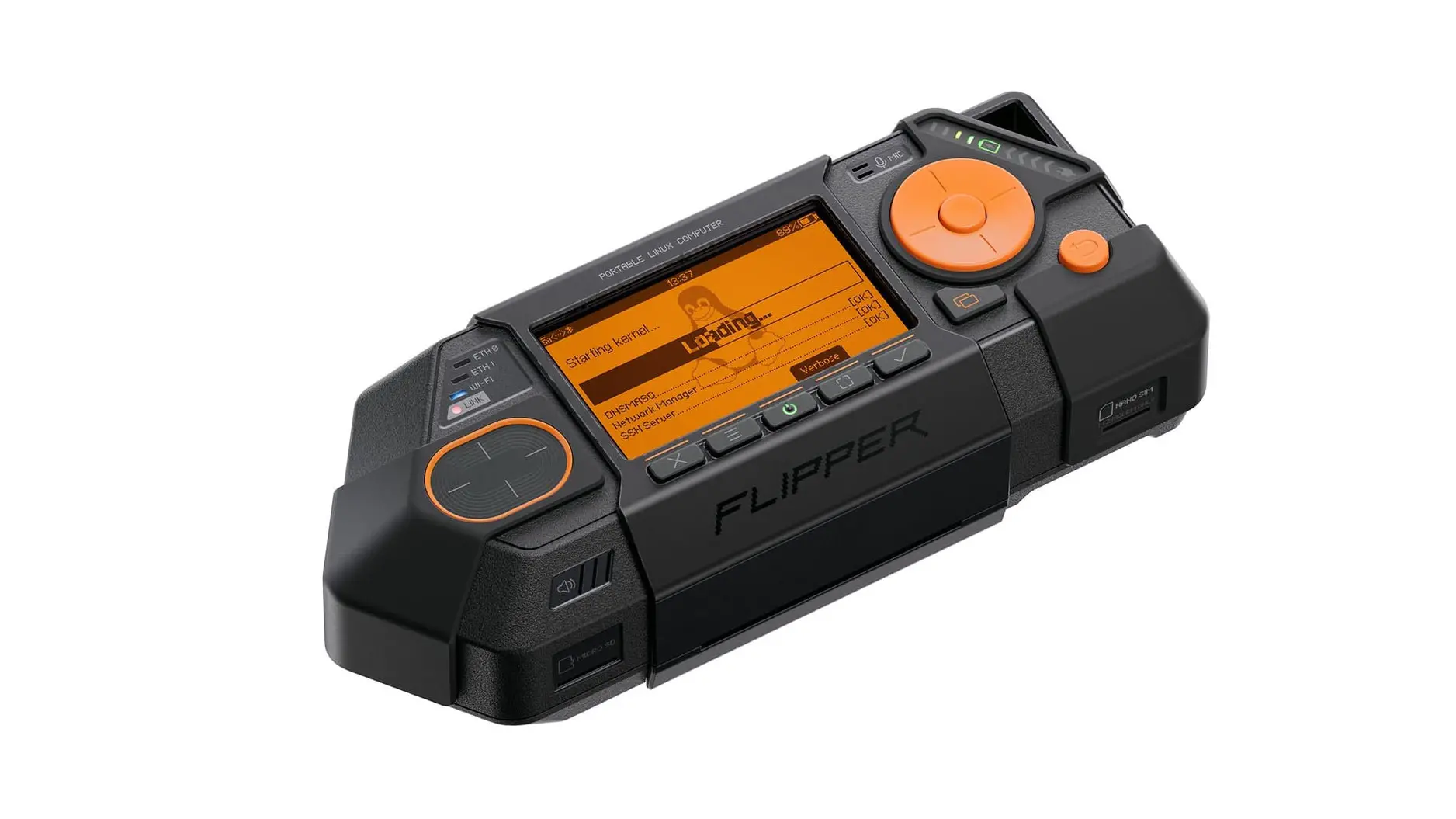
Flipper Zero, the palm-sized multitool that captured the imagination of security enthusiasts and tech hobbyists alike, is getting a bigger, more powerful sibling. Flipper, the company behind the iconic pen-testing device, has announced its next-generation project: the Flipper One. While the Zero specialized in short-range communication protocols like RFID, NFC, and infrared for ethical hacking and vulnerability assessment, the One is designed to be a full-fledged Linux computer capable of connecting to virtually any IP-based network. This includes widespread technologies such as 5G, Wi-Fi, Ethernet, and even satellite networks using Non-Terrestrial Network (NTN) connectivity.
From Security Tool to Open Cyberdeck
The Flipper One is not intended as a direct successor to the Zero, but rather as a distinct category of device. Where the Zero was a portable security research gadget with limited computing capabilities, the One aims to be a versatile, open computing platform. The company describes it as "a hacker's Lego set"—a modular system that users can configure to their exact needs, both in hardware and software. This philosophy extends to the core operating system: the Flipper One will run a Debian-based Linux distribution that is fully open source and supports the mainline Linux kernel. This means that every new kernel update released by Linus Torvalds and the community will be directly applicable to the device, without the need for proprietary patches or binary blobs. In theory, this ensures that the hardware will always be compatible with the latest software, limited only by its computational power.
Hardware: A Dual-Chip Approach
At the heart of the Flipper One lies a dual-processor architecture designed to balance performance and flexibility. The primary compute unit is a Rockchip RK3576 system-on-chip (SoC), which features an eight-core CPU (a mix of Cortex-A72 and Cortex-A53 cores), a Mali-G52 GPU for graphics acceleration, and a neural processing unit (NPU) capable of running small AI models on-device. This SoC is paired with 8GB of RAM, providing ample memory for multitasking, web browsing, software development, and even lightweight machine learning tasks. Complementing the Rockchip chip is a Raspberry Pi RP2350 microcontroller, a dual-core ARM Cortex-M0+ device with 16MB of flash memory. This microcontroller handles low-level system functions such as driving the display, reading button inputs, controlling the touchpad, managing LEDs, and supervising the power subsystem. Flipper notes that the RP2350 is powerful enough to run the device independently for basic tasks, allowing the main SoC to sleep when not needed, thereby saving power.
Modularity and Customization
A key differentiator of the Flipper One is its modular design. The device will feature standard GPIO connectors that allow users to attach a wide range of expansion modules, such as additional sensors, radios, storage, or custom hardware. Flipper plans to release 3D printable models for the device enclosure and internal structures, enabling users to design and manufacture their own custom cases or add-ons. This approach lowers the barrier for hardware hacking and prototyping, making the Flipper One an ideal platform for educational projects, embedded systems development, or niche applications like mesh networking or environmental monitoring. The company has also established a Developer Portal that will serve as a comprehensive resource—essentially a Wikipedia for everything Flipper One, including schematics, datasheets, software libraries, and community guides. This open documentation is intended to empower developers to contribute to the platform's evolution from day one.
Connectivity and Use Cases
The inclusion of 5G and satellite connectivity sets the Flipper One apart from typical single-board computers like the Raspberry Pi or BeagleBone. With 5G NR support, the device can act as a mobile hotspot, a remote sensor gateway, or a field-deployable server in areas with cellular coverage. The NTN satellite connectivity—utilizing constellations like Iridium, Globalstar, or upcoming LEO networks—allows operation in completely off-grid locations, making it suitable for disaster response, wilderness research, or long-distance data relay. Additionally, the device will have Wi-Fi 6E and Bluetooth 5.3 for local area networking, as well as a USB-C port with power delivery for both data and charging. The designers envision the Flipper One as a portable cyberdeck that can be used for penetration testing, software development, IoT prototyping, and even as a daily driver for privacy-conscious users who want full control over their hardware.
Development Timeline and Community Involvement
Flipper has been transparent about the early stage of the project. The device is not yet ready for production, and the company is going public now to gauge interest and attract funding for development. Founder Pavel Zhovner has stated that his goal is to create "the most open and best-documented ARM computer in the world," and the Developer Portal is a first step toward building a collaborative community. The company is soliciting feedback from developers, academics, and tinkerers to refine the hardware and software. While no hard date for release has been given, early prototypes are expected to surface within the next year, with a potential crowdfunding campaign later in 2024 or early 2025. In the meantime, Flipper continues to support its existing Zero user base with updates and new accessories.
The Flipper One represents a bold vision for personal computing: a device that is as much a tool for exploration as it is a platform for creation. By combining the hacker ethos of the Zero with the flexibility of open-source Linux and cutting-edge wireless technologies, Flipper is attempting to build something that goes beyond typical consumer electronics. Whether it succeeds will depend on community adoption and the execution of its ambitious roadmap. For now, the company is inviting anyone with a passion for open hardware to get involved early. Those interested can visit the Developer Portal to access preliminary documentation, sign up for updates, and participate in forums. The project's ultimate success may hinge on how well it balances the openness that hackers crave with the polish needed for broader adoption. But if the Flipper Zero's viral success is any indicator, the Flipper One has the potential to become another iconic device in the world of cybersecurity and DIY computing.
Source: Android Authority News