

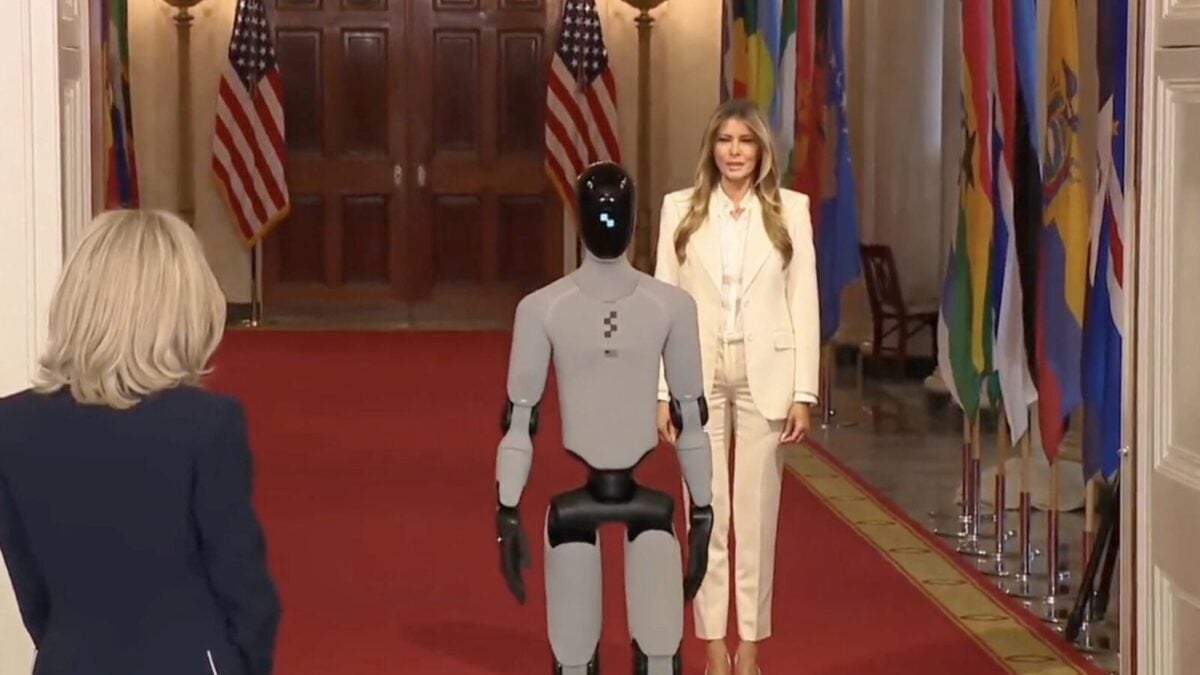
On March 25, 2026, Brett Adcock, the CEO of Figure AI, took to social media to announce that his company's F.03 concept robot had made history by being labeled as "the first humanoid robot in the White House." The claim came during a two-day summit associated with First Lady Melania Trump’s initiative, "Fostering the Future Together," aimed at promoting technology in education.
The F.03 robot made a brief appearance at the event, delivering remarks in multiple languages before it silently walked away, leaving an eerie impression reminiscent of past presidential encounters with technology.
However, this raises the question: is this truly the first humanoid robot to visit the White House? There are compelling arguments both for and against this claim.
In 2015, President Barack Obama engaged with a telepresence robot to meet disability advocate Alice Wong, though this device, primarily a screen on a wheeled base, does not fit the traditional definition of humanoid. More notably, Honda's Asimo robot has met various leaders worldwide, including President Obama during a soccer demonstration in Tokyo, but never at the White House.
George W. Bush encountered a humanoid robot named Albert HUBO at the APEC summit in 2005 in South Korea, which sported a rather unsettling animatronic head of Albert Einstein. Again, this was not a White House event.
Interestingly, if we look back to Ronald Reagan's presidency, he received a Tomy Omnibot 2000, a robotic toy, during a visit to Purdue University in 1987. This robot, with its wheels instead of legs, complicates the narrative as it may not strictly meet the criteria to be termed "humanoid" by all definitions.
While the Omnibot could have been in the White House, it would have been approximately 40 years before the F.03's arrival. However, its qualification as a humanoid robot is debatable, given its design.
To clear up any ambiguity, a formal introduction of a humanoid robot by a sitting president in the Oval Office would undoubtedly mark a significant milestone. This scenario is plausible, especially considering recent discussions where President Trump expressed a keen interest in integrating robots into various sectors, including workforce management. During a press conference in December, he spoke extensively about the role of robots in supporting labor demands for upcoming projects.
Trump’s remarks highlighted the need for both human labor and robotic assistance, suggesting that a future where robots play an integral role in the White House could be on the horizon. He stated, "We’re gonna have tremendous workforce availability. We’re also gonna have robots helping us... in order to operate the—you’re always gonna need people."
Should a robot be employed at the White House, serving as an assistant to the staff, it would represent a more significant milestone than a ceremonial appearance during an education summit.
As it stands, Adcock's assertion about the F.03 being the first humanoid robot in the White House is plausible yet contested. The White House Historical Association has been contacted for expert insights, and updates to this claim may follow.
This discussion opens a broader dialogue about the evolving relationship between technology and governance, as well as how the perception of robots in society continues to shift.
Source: Gizmodo News